Mechanical Testing
Chemistry tells you what an alloy is. Mechanical testing tells you what it will do under load: where it yields, what it takes to break it, how much it stretches first, and whether it stays tough at the temperature it actually runs at. The range runs from thin polymer sheet, elastomers, and coated or lined materials at one end to bar, plate, forgings, pipe, and welded sections in carbon and alloy steel at the other. Our laboratory is in Stafford, Texas, serving Greater Houston, and we accept samples shipped from anywhere.
Laboratory
11,000 to 120,000 lbf
Tensile · impact
Polymers, coatings, metals
Mechanical testing is how a specification gets checked against reality. The range we cover is unusually wide, from polymer and coating samples that fail under a few hundred pounds to steel sections that need more than a hundred thousand, so the same work that identifies your material can also tell you what it will carry.
Tensile testing
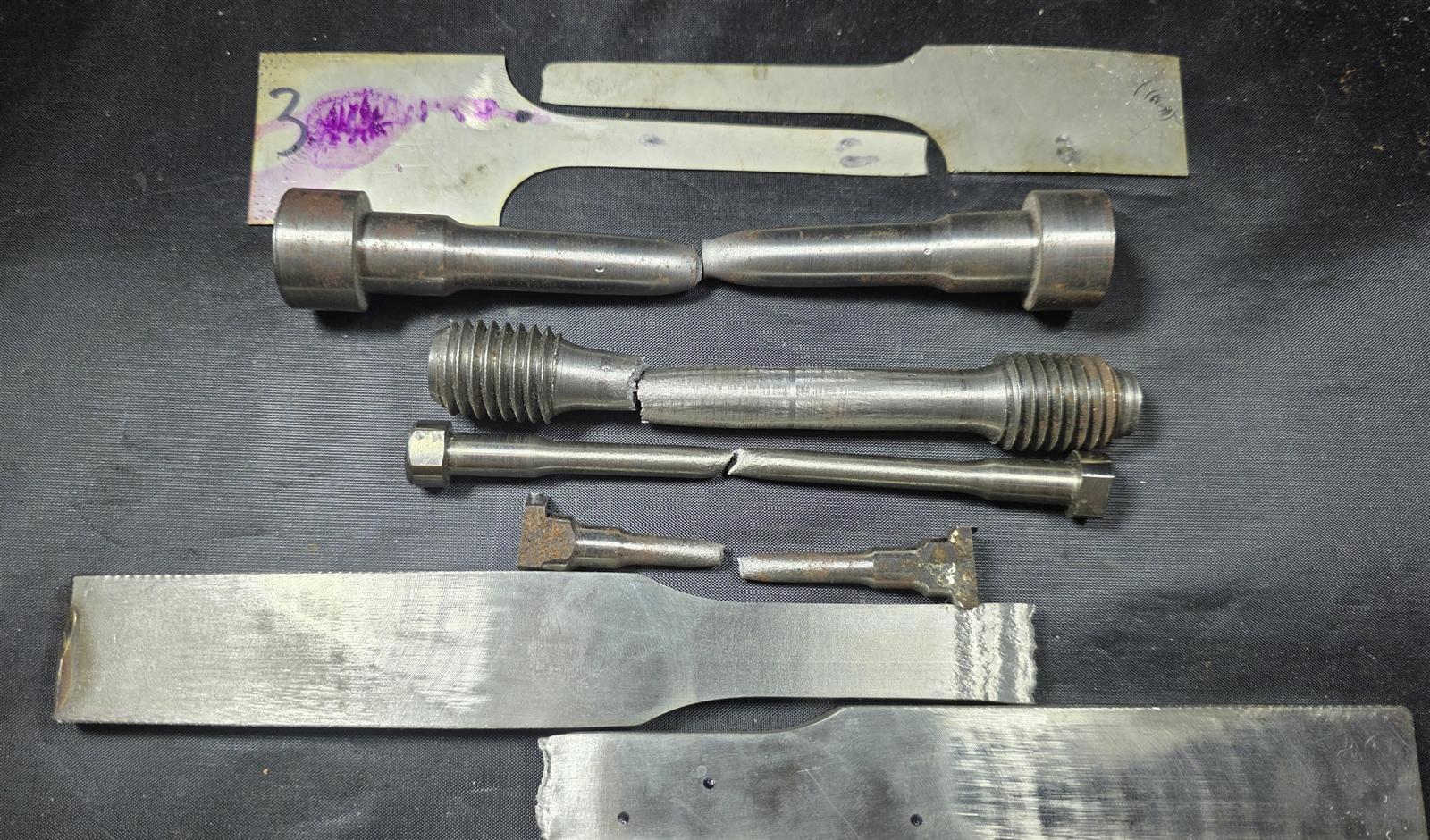
A tensile test pulls a machined specimen to failure and records the whole story on the way: the load at which permanent deformation begins, the maximum the material carries, and how far it stretches before it lets go. Testing follows ASTM E8/E8M for metallic materials and ASTM A370 for steel products, with ISO 6892-1 where a job is written to ISO or EN rather than ASTM, and ASTM D638 for plastics.
Reported values are the ones a specification is written around:
- Yield strength, normally 0.2% offset, or upper and lower yield where the material shows a distinct point
- Ultimate tensile strength
- Elongation over a defined gauge length
- Reduction of area
Specimen form follows the product: round specimens from bar, forgings, and heavy sections; flat or strip specimens from plate and sheet; full-section or strip specimens from tube and pipe; and sub-size specimens when a failed component only yields so much material.
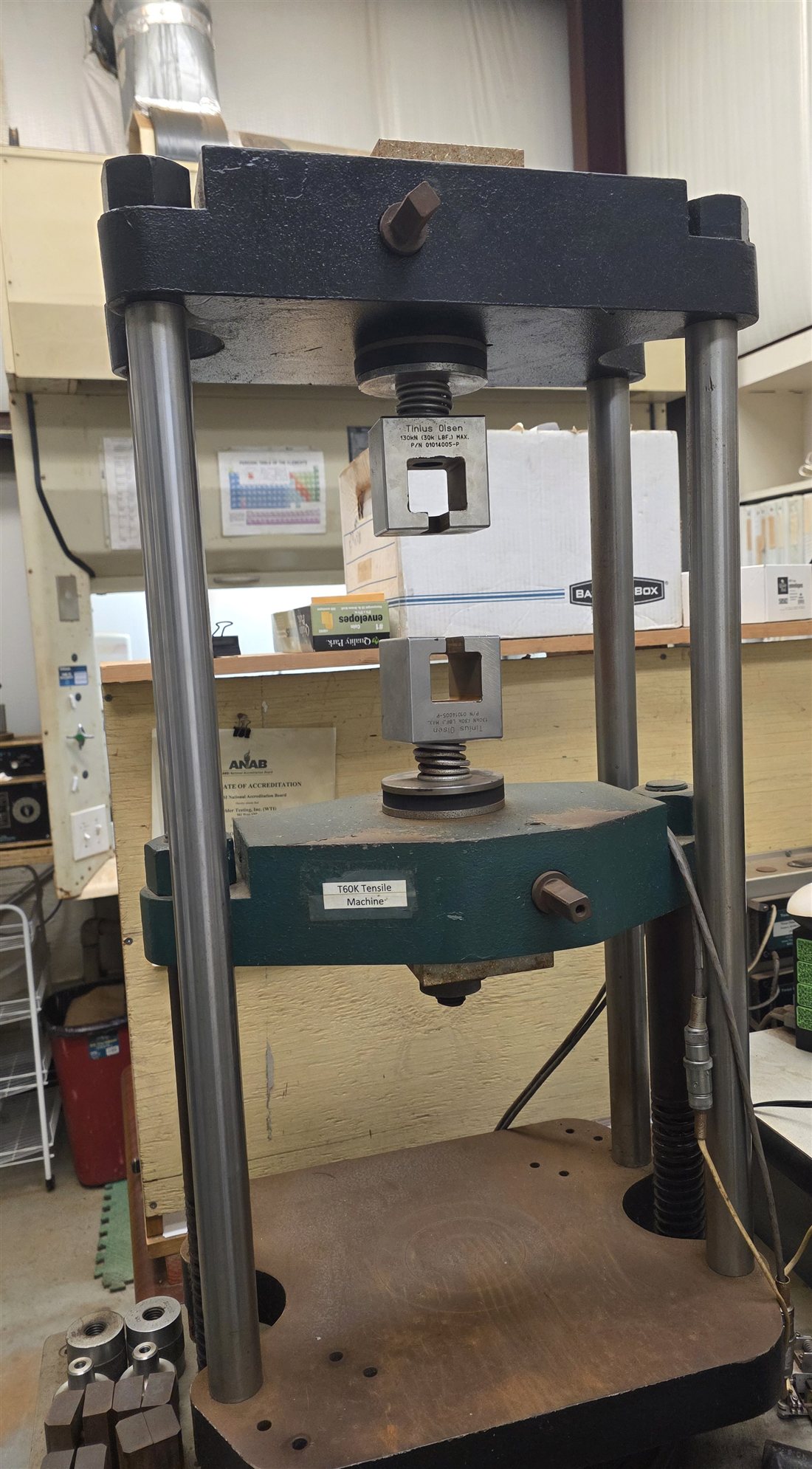
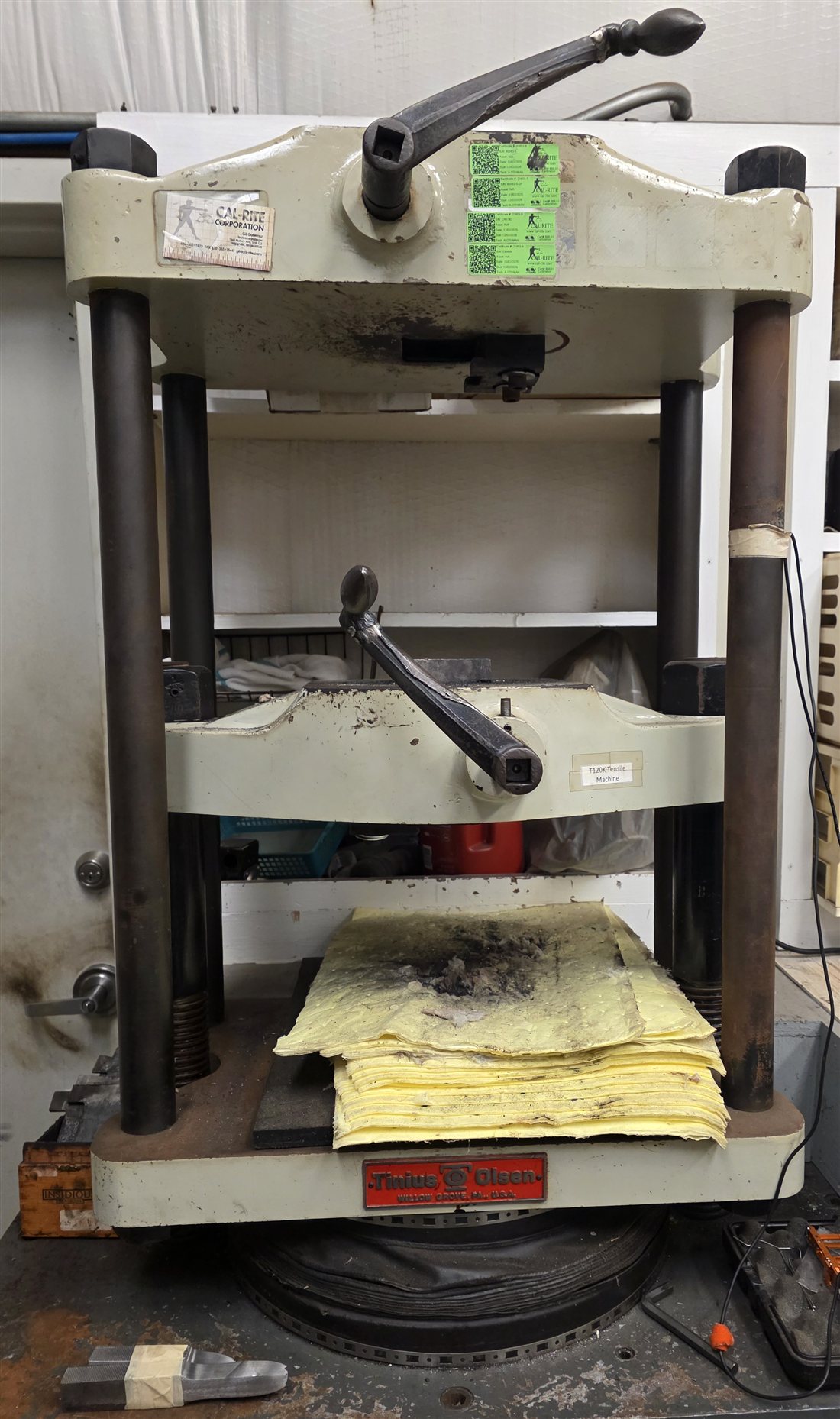
Three tensile testing machines
Those specimens are pulled on three machines. Two carry the metals work, one rated to 60,000 lbf and the other to 120,000 lbf, while a third, rated to 11,000 lbf, is kept for polymers, coatings, and thin sections. The specimen decides which machine it runs on, since a load has to sit well inside a machine's range before the numbers mean anything.
From coatings and polymers to heavy steel
Very few metallurgical labs cover both ends of this range. A frame sized for pipe steel cannot resolve the few hundred pounds that break a polymer dogbone, and a frame sized for polymers cannot begin to load a plate coupon. Having all three available means a plant that runs steel piping, a polymer liner, and a coated vessel gets its answers on one report, interpreted against one another.
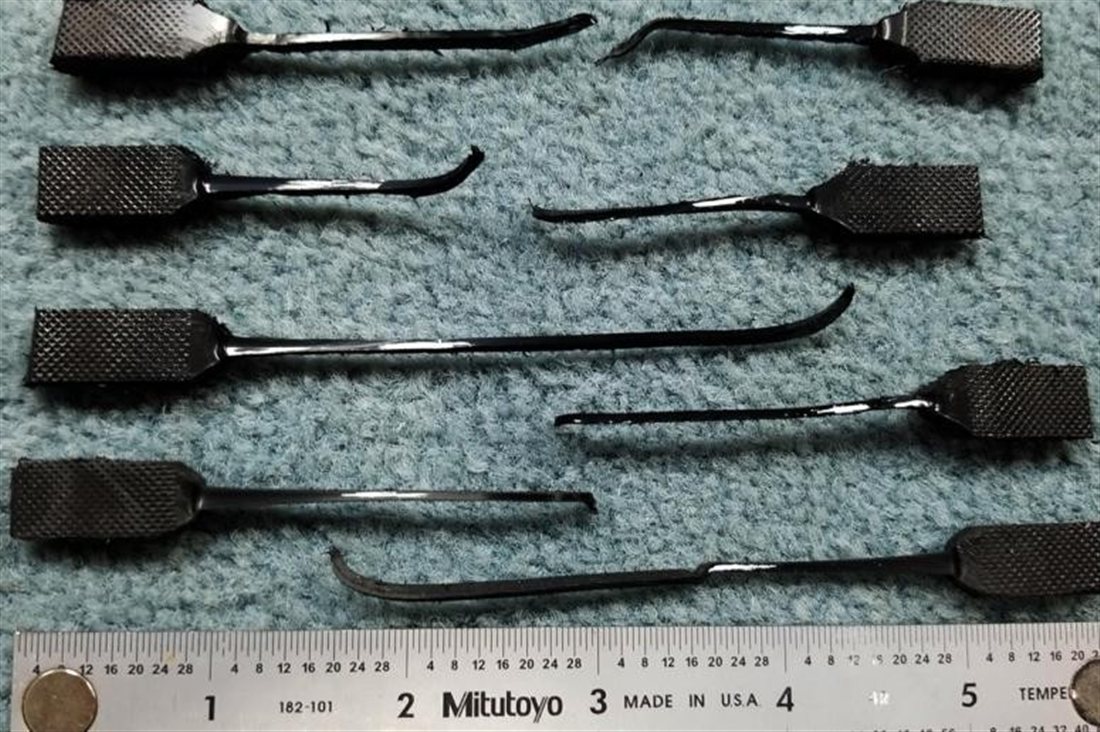
On the light frame we test polymer and elastomer specimens, including HDPE, PP, ECTFE and TPV, thin sheet and strip, and coated or lined materials, both as pull-off adhesion on the coating itself and as tensile testing of the coated substrate, where the question is how the system behaves rather than the substrate alone. That work sits naturally alongside our coating analysis, where thickness, adhesion, and defects are measured on a cross-section.
Impact testing
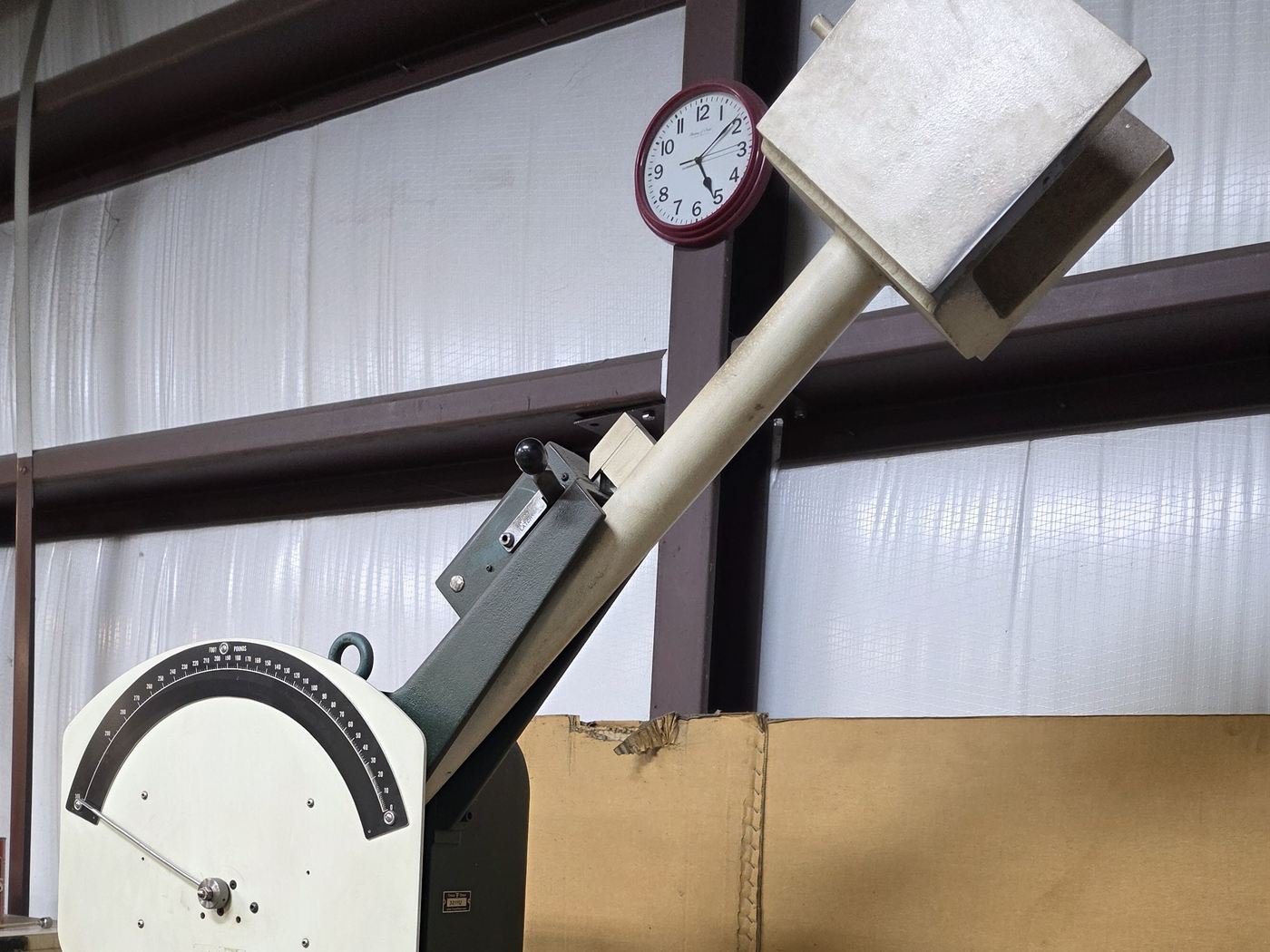
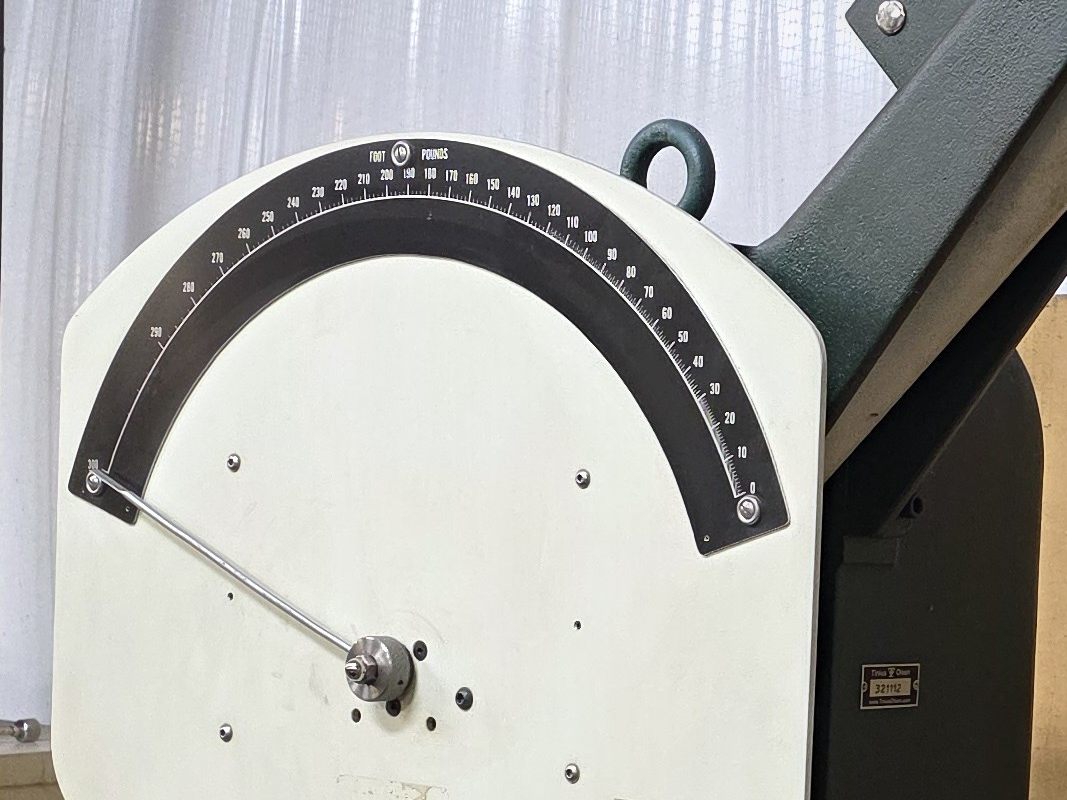
Charpy V-notch impact testing to ASTM E23 measures toughness, the energy a material absorbs when it is struck rather than pulled, and it is the test that exposes brittle behaviour a tensile test will not. Results are reported as absorbed energy with lateral expansion and percent shear fracture, and can be run as a temperature series to locate the ductile-to-brittle transition, which is the number that decides whether a steel is fit for cold service.
The pendulum machine is rated to 300 ft-lb, which puts full-size specimens in carbon and low-alloy steel comfortably inside its range. The same rule applies here as on the tensile frames: a reading has to sit well inside the machine's capacity to mean anything, and ASTM E23 treats a result as valid only while the absorbed energy stays below about 80% of the rating.
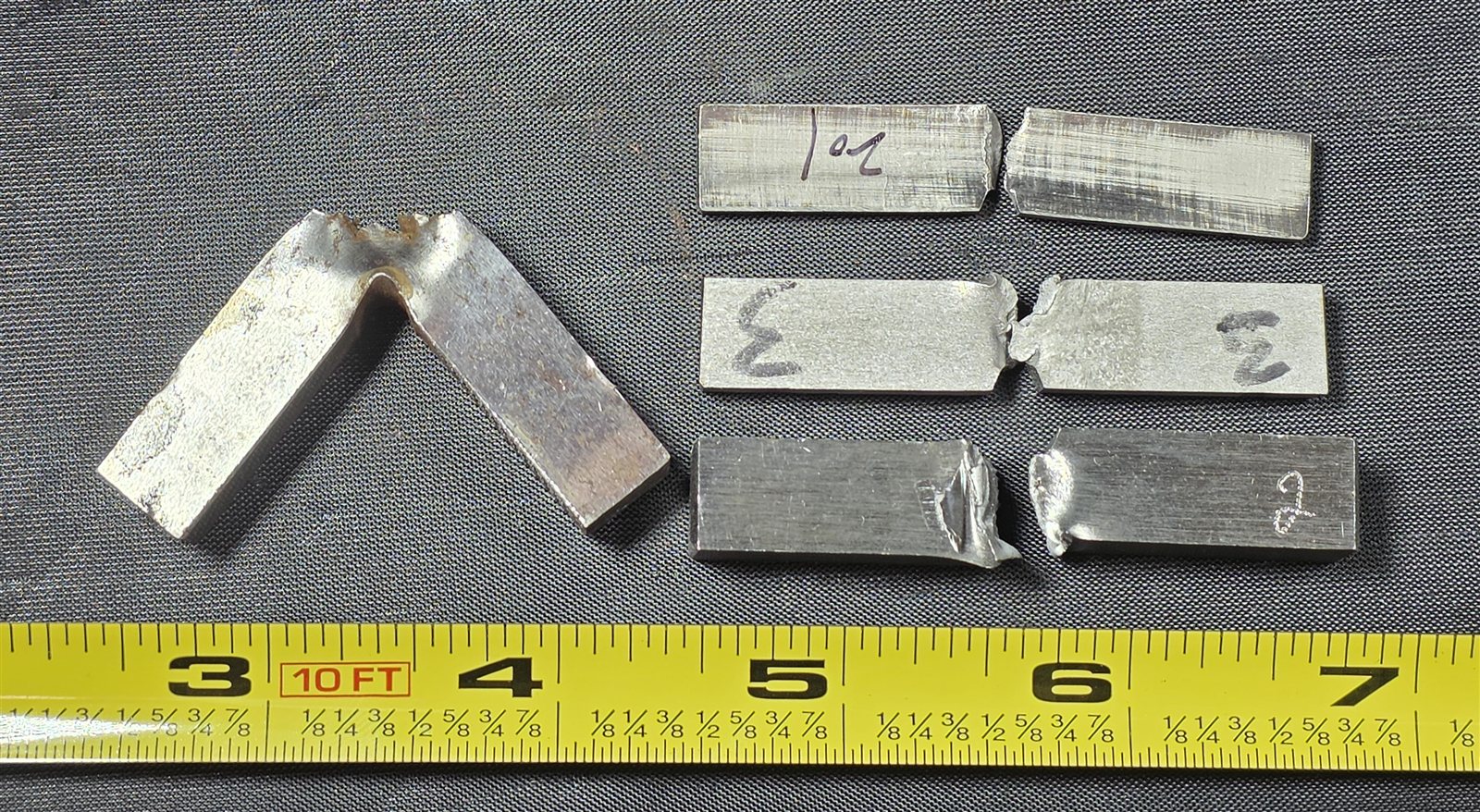
Transverse tensile specimens cut across a weld are part of the mechanical testing behind a weld procedure or welder qualification under ASME Section IX or AWS D1.1, and impact specimens can be notched in the weld metal or the heat-affected zone where the code calls for them.
Testing welds and components
Where a specimen is taken from decides what it means. Orientation relative to the rolling direction, position relative to the weld and its heat-affected zone, and depth through the wall all change the result, so specimen layout is planned before anything is cut, and recorded with the results. For failure work the layout usually pairs a specimen from the failed region with one from sound material on the same component, which turns a single number into a comparison.
Reading the fracture
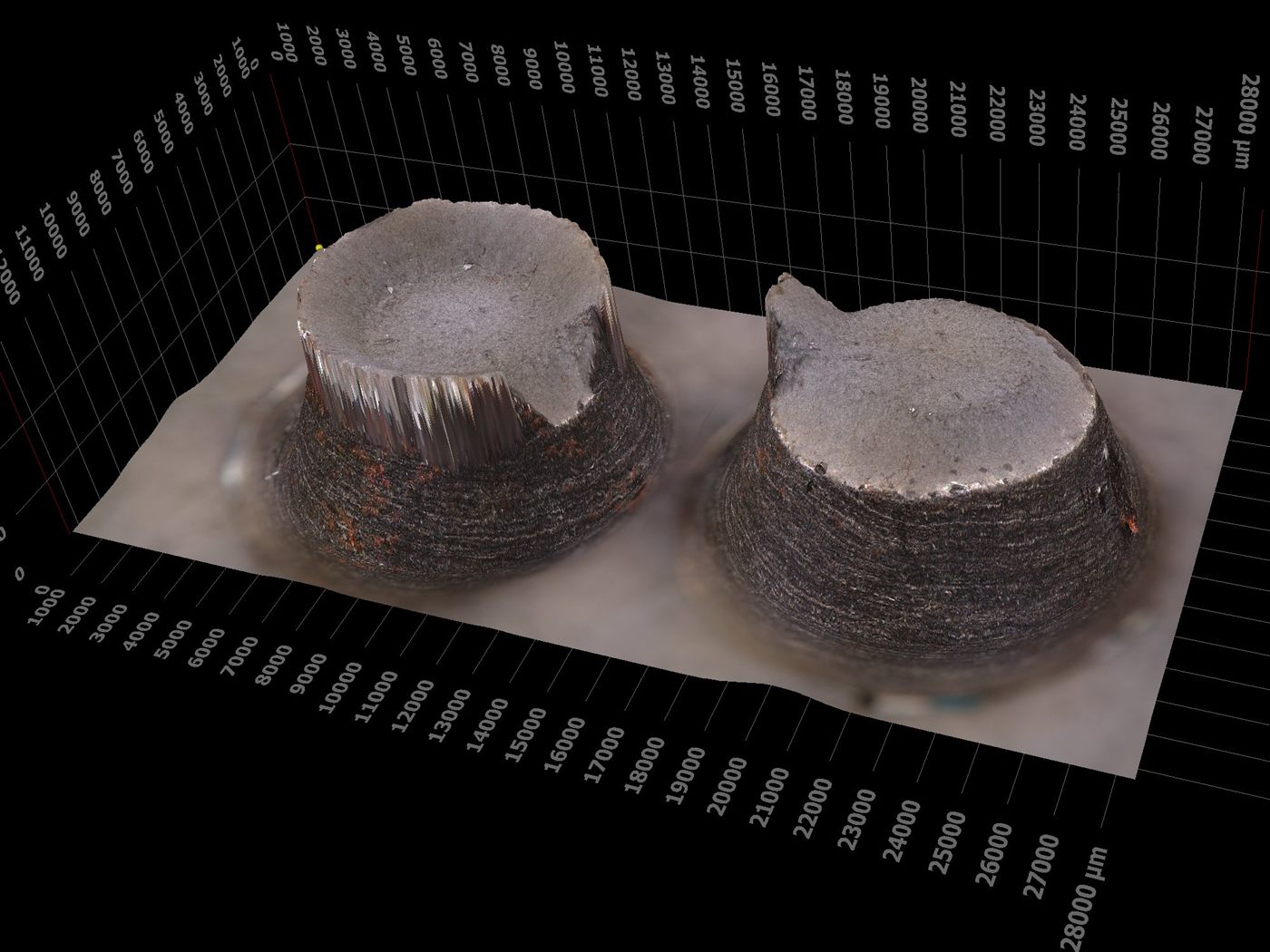
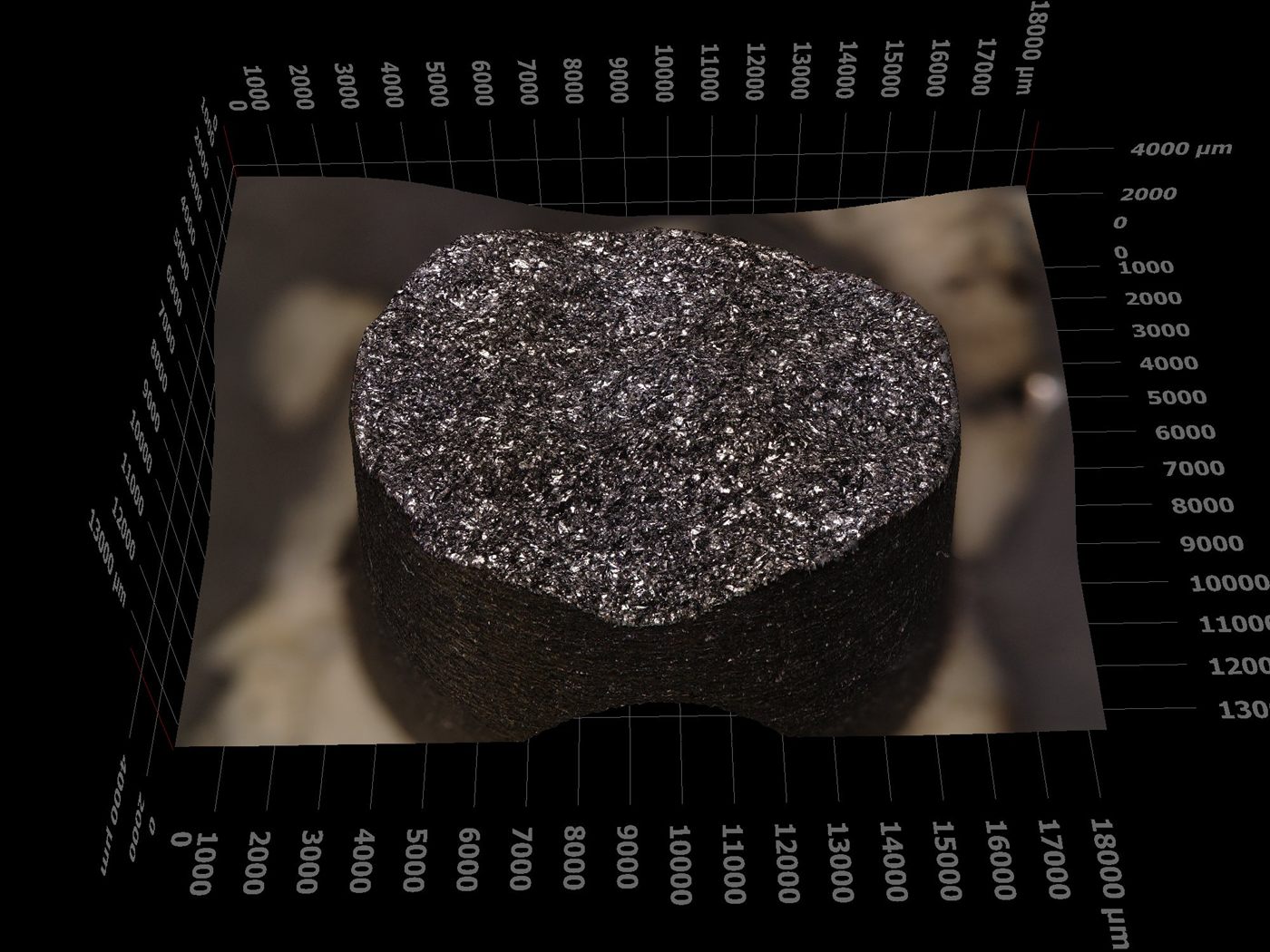
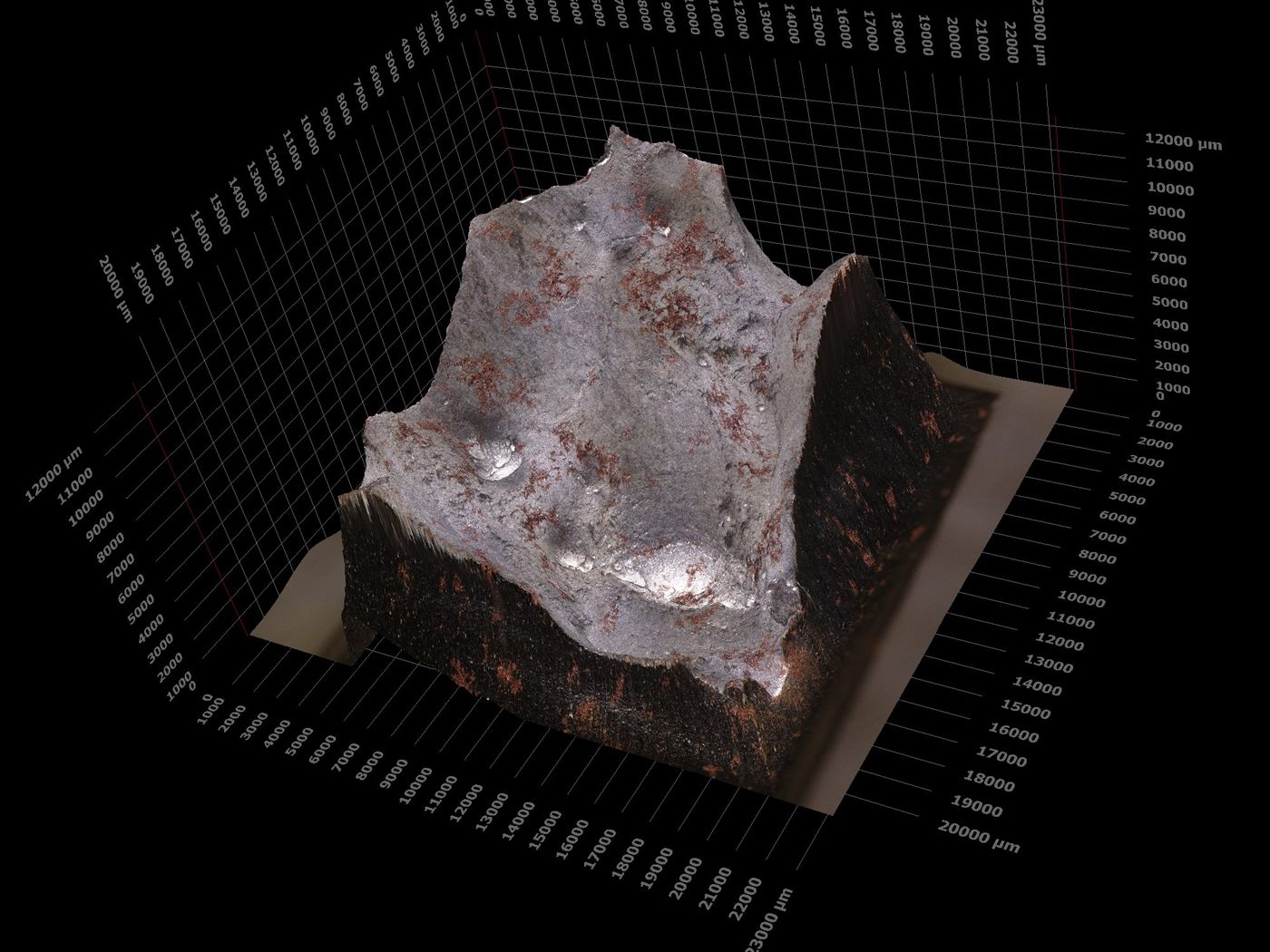
The number a test returns and the surface it leaves behind are two separate pieces of evidence. A ductile tensile failure necks down and tears from the centre outward, finishing in shear around the rim, and leaves the cup-and-cone shape that says the material deformed a long way before it gave up. A brittle failure separates flat across the section with almost no reduction of area. Two specimens can fail at a similar load and mean entirely different things.
Where that distinction matters, the fracture surface is imaged and reconstructed in three dimensions on the Olympus DSX1000, so relief, height, and fracture area are measured rather than estimated from a photograph. It is also where mechanical testing hands off to failure analysis: fatigue striations, intergranular separation, and secondary cracking are read off the fracture surface, not the load curve, and they are what decide whether a low result points at the material, the fabrication, or the service it saw.
Where it fits with the rest of the work
Mechanical results are most useful next to the metallurgy that explains them. A low yield strength means one thing on its own and something far more specific when the microstructure shows a missed heat treatment. A tensile test that fails a specification is the beginning of a failure analysis, not the end of the job. Where a component cannot be sectioned at all, Automated Ball Indentation derives yield and tensile properties in place, non-destructively, and hardness testing gives a fast, local strength indication on prepared cross-sections.
What we need from you
- The material specification and grade the part was bought to, if known
- Enough material to machine the specimens, or the component itself so we can plan the layout
- The service conditions that matter, particularly minimum design temperature for impact work
- The question behind the request: qualification, spec compliance, fitness-for-service, or failure investigation
Both ends of the range
Polymer dogbones drawn out and torn, and steel Charpy bars broken across the notch.
What the break looks like
Fracture surfaces from specimens broken on these machines, reconstructed in 3D. The scales are in microns.
Often ordered together
Failure Analysis
When a part broke in service and the mechanical numbers are one line of evidence among several.
View serviceAutomated Ball Indentation
Yield and tensile properties measured in place, without cutting a specimen out of the asset.
View serviceHardness Testing
Rockwell, Brinell, Vickers, and Knoop on prepared sections, welds, and heat-affected zones.
View serviceFrequently asked questions
What are your mechanical testing capabilities?
Tensile and Charpy V-notch impact testing. Two machines handle metals, rated to 60,000 and 120,000 lbf, and a third rated to 11,000 lbf covers polymers, coatings, and thin sections. Impact testing runs on a pendulum machine rated to 300 ft-lb. Results are interpreted by our engineers.
What does a tensile test tell you?
Yield strength, ultimate tensile strength, elongation over a defined gauge length, and reduction of area. Together they describe how strong a material is and how much it deforms before it breaks, which is what most material specifications are written around.
Can you test plastics and coatings, not just metals?
Yes, and that range is unusual for a metallurgical lab. The 11,000 lbf frame is sized for polymers, elastomers, thin sheet, and coated or lined materials, where a heavy frame cannot resolve the loads involved. Plastics testing follows ASTM D638.
Which standards do you test to?
ASTM E8/E8M and ASTM A370 for metals, ASTM D638 for plastics, ISO 6892-1 where a job is written to ISO or EN rather than ASTM, and ASTM E23 for Charpy V-notch impact. Weld qualification work follows ASME Section IX or AWS D1.1.
Why test a part that already has a mill certificate?
A certificate reports the heat as it left the mill. It cannot account for fabrication, welding, heat treatment, chemical exposure, or years of service, all of which change properties. Testing the actual part is the only way to know what it is capable of now.
Can you test a weld?
Yes. Transverse tensile specimens across the weld are part of the mechanical testing behind a weld procedure or welder qualification, and impact specimens can be notched in the weld metal or the heat-affected zone as the code requires.
How much material do you need?
Enough to machine specimens to the governing standard, though sub-size specimens can often be used when a failed component offers little material. Send the component itself where possible so specimen layout can be planned against the failure, the weld, and the wall thickness.
Is there a non-destructive alternative?
Yes. Automated Ball Indentation derives yield and tensile properties from an instrumented indentation made directly on the component, in the field, without removing material. It is the right choice when the asset cannot be cut; a machined tensile specimen remains the reference method when it can.
Find out what it can actually take
Send us the part or the specification and we will scope the testing around the question you need answered.