
Positive Material Identification
On-site material verification performed by technicians cross-trained in instrument technology, alloy composition, metallography, and industry standards, confirming what your components are made of without damaging your parts.
Field / On-Site
Non-destructive
Nearly any alloy
Alloy verification
Positive Material Identification (PMI) is a fast, non-destructive test that confirms what alloy a component actually is, verified in place with portable XRF, OES, and LIBS analyzers, so mismarked or mixed-up materials are caught before they cause a leak, fire, or failure.
Verification in the field
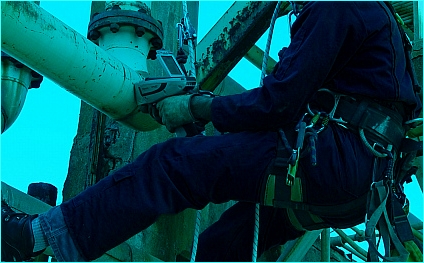
Positive Material Identification confirms the composition of installed and incoming components right where they sit. Our technicians are cross-trained in instrument technology, alloy composition, metallography, and industry standards, so they can identify materials without damaging your parts and keep your project moving.
What we can identify
We can identify nearly any metal or alloy, with or without coatings, ranging from common steels to exotic and specialty materials. That reach spans maraging alloys, everything from Armco iron pipe to API X80 line pipe, and international grades including Chinese and French specifications.
Alloy verification
Drawing on more than two decades of experience running Retro PMI programs, our technicians perform field-based alloy verification. When a case is complex, it escalates to our laboratory Ph.D.s, who resolve it using appearance, chemical composition, in-situ macro- and micro-structures, and hardness.
Ferrite content analysis
We operate a fleet of Fischer Ferritescopes to measure ferrite in duplex materials and to help detect the presence of sigma phase in duplex and super-duplex materials, with reporting that meets or exceeds all known specifications.
Carbon content analysis
Using OES and LIBS technology, we can measure carbon in L-grade stainless steels in amounts as small as 0.008%, and evaluate carbon in carbon steels and nickel alloys, confirming the low-carbon grades that resist sensitization.
Heat-treatment verification
Through in-situ metallography and hardness testing, our technicians differentiate heat-treatment states and grade precipitation-hardened alloys such as 17-4 PH and Inco 718.
PMI in action
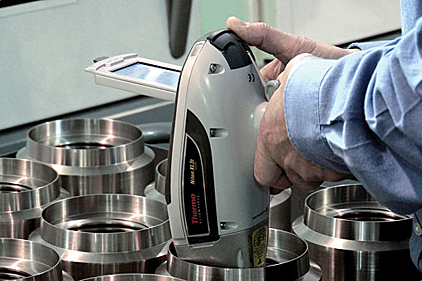
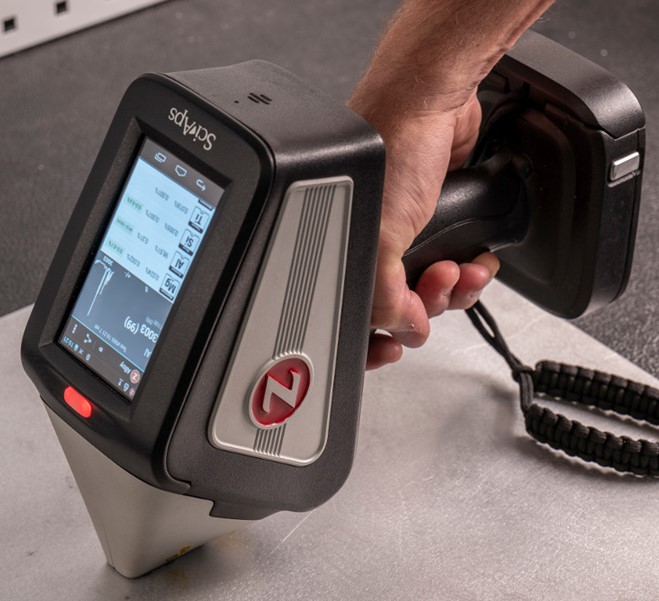
Portable XRF, OES, and LIBS verifying alloy chemistry on site.
Often ordered together
Chemical Analysis
Laboratory-grade composition to confirm and document alloy chemistry.
View serviceOn-Site Hardness Testing
Portable hardness measurement to help verify grade and heat-treat condition.
View serviceAutomated Ball Indentation
Non-destructive measurement of strength properties on installed components.
View serviceFrequently asked questions
Is PMI testing destructive?
No. PMI is non-destructive. Components are verified in place, without cutting, coring, or removing them from service.
Which instruments do you use for PMI?
Portable XRF, OES (optical emission spectroscopy), and LIBS, chosen to match the alloy and the element in question. OES and LIBS are used when carbon or other light elements must be measured.
Can PMI tell apart L-grade stainless steels by measuring carbon?
Yes. Using OES and LIBS we can measure carbon in L-grade stainless steels down to about 0.008 percent, confirming the low-carbon grades that resist sensitization.
What materials can you identify?
Nearly any metal or alloy, with or without coatings, from common carbon steels to duplex and super-duplex, precipitation-hardened alloys such as 17-4 PH and Inconel 718, and international grades.
Can you measure ferrite content or detect sigma phase in duplex stainless?
Yes. We operate a fleet of Fischer Ferritescopes to measure ferrite in duplex materials and help detect sigma phase in duplex and super-duplex materials.
Where do you provide on-site PMI?
We are based in Stafford, Texas and serve the Gulf Coast, and our field technicians deploy nationwide and worldwide for on-site programs and turnarounds. Complex cases escalate to our Ph.D. laboratory.
Need your materials verified on-site?
Tell us the scope and schedule. Our field technicians will confirm your alloys in place and deliver a defensible report, with lab support when a case calls for it.